


A Replicable Playbook
Special shoutout to SYS for helping to curate amazing dinner experiences, and co-write this playbook.
A solarpunk dinner is an engineered descent — from guardedness into real connection. People can’t be vulnerable on command. They can only open when their nervous system reads the room as safe. So the whole evening is built to send safety signals first and ask for depth second.
People don’t join movements out of arguments but out of feelings.
Get the conditions right and the conversation takes care of itself.
Enjoy some very gentle piano over your next dinning experience ;)
What’s Special about Dinner Parties?
Meals are one of the oldest and most potent technologies to connect people. They are how families bond and nourish each other.
Family-style dinners have worked magic for us here at Agartha, so we want to share som insights with our greater community.
Fractal NYC, a large co-living community with 75+ residents and 100+ yearly events with over 1000 attendees, started their journey with weekly dinner events. These dinner gatherings provided a heartbeat to the community, and also solved a practical necessary need.
My husband and I have hosted a weekly dinner party for over a year. We host it even when we’re tired or depressed or busy or feeling anti-social. We host it because of the magical friendship group juju that arises out of regularity. But a side effect is that our friends have become very familiar with our neighborhood.
— How to Live Near Your Friends by Priya, one of the founders of Fractal NYC
Humans have been connecting over meals over centuries, and dinner parties are one of the most simple, effective recipe of bringing a community together.
At Edge Esmeralda, we hosted 12 dinner parties and welcomed over 270 guests in 4 weeks. Some of them are larger day event house parties, some of them are themed events combined with presentations and special topics.
Here is a summary of our experience, what worked well, and what to take forward from this experience:
Designing the Vibe
Safety — a regulated nervous system. Warmth, fullness, laughter, soft light, slowness, and no sense of threat shift people out of fight-or-flight and into the parasympathetic “rest and connect” state. That state is the precondition for vulnerability. You cannot skip it. Everything in the first hour exists to produce it.
Beauty — neuroaesthetics. A clean, beautiful, nature-rich space filled with art measurably calms the brain and opens people before a word is spoken. Beauty here isn’t decoration; it’s the reimagining of a beautiful future made physical — which makes it the most solarpunk thing in the room. “You have to make the future feel irresistible before you can make it feel possible.”
Belonging — a curated, held group. Small enough that everyone is seen, chosen with care, and guided by hosts who are themselves calm and present. The room borrows the host’s nervous system.
Agartha’s Special Flavor
Dinners aren’t just a break from the work — it’s a nourishing ground the best work grows in. As our bodies get nourished, so do our minds. A depleted, guarded, over-stimulated nervous system produces fear-based, conforming work. A nourished, safe, connected one produces brave, original work.
Shared meals isn’t just about hospitality; it is a beautiful communal ritual and a Solarpunk infrastructure.
We consolidated Agartha’s four pillars to provide a special experience.
Planetary Regeneration. It starts with the body. Abundant, local, real food; a slow pace; warmth — the same regenerative logic we bring to soil, brought to people. Human thriving and ecological thriving require each other, and a sprinting, under-nourished builder is its own kind of depleted land. We also prompt people to contemplate on where the foods come from, and the more we opt in for organic, local options (something we intend to be more rigorous about), the more impact we make towards a regenerative planet.
Loving Community. Connection, warmth, deep listening, co-creation — a room where people are seen as who they are, not networked. “How we treat ourselves and each other is how we shape the world.” The dinner is that concept being deeply embodied and practiced.
Spiritual Growth. The depth the questions invoke — presence, honesty, meaning. Set in smaller groups so everyone can be heard. The inner work that can only surface once the body feels safe. This is where people meet their calmest, truest selves, underneath the performance.
Ethical Technology. Ethical technology here is the live reminder of what the tools are for: human flourishing, not human replacement. The dinner is the layer that gives the whole stack its meaning — the place conscious, caring, capable builders discuss why they build.
Run it right and you get the thing Agartha is actually after: people in their best, calmest, most alive selves — and that, not the grind, is where their best work comes from. “Wisdom is no longer about what you know. It’s about how you live.”
Designing the Invitation
When you try to connect way too many people in way too small of a space, the energy becomes chaotic, and easily diffused. At some of the big community dinner gatherings, you never know who you’d end up sitting next to, people get excited and start talking louder and louder so they can hear each other. Before you know it, everybody is screaming. You leave for home with your ears ringing, yet still feel FOMO from not having had enough deep connections.
We wanted to create an experience that relaxes people, a space where you can unmask and be yourself, where you can go really deep with people even though you just met.
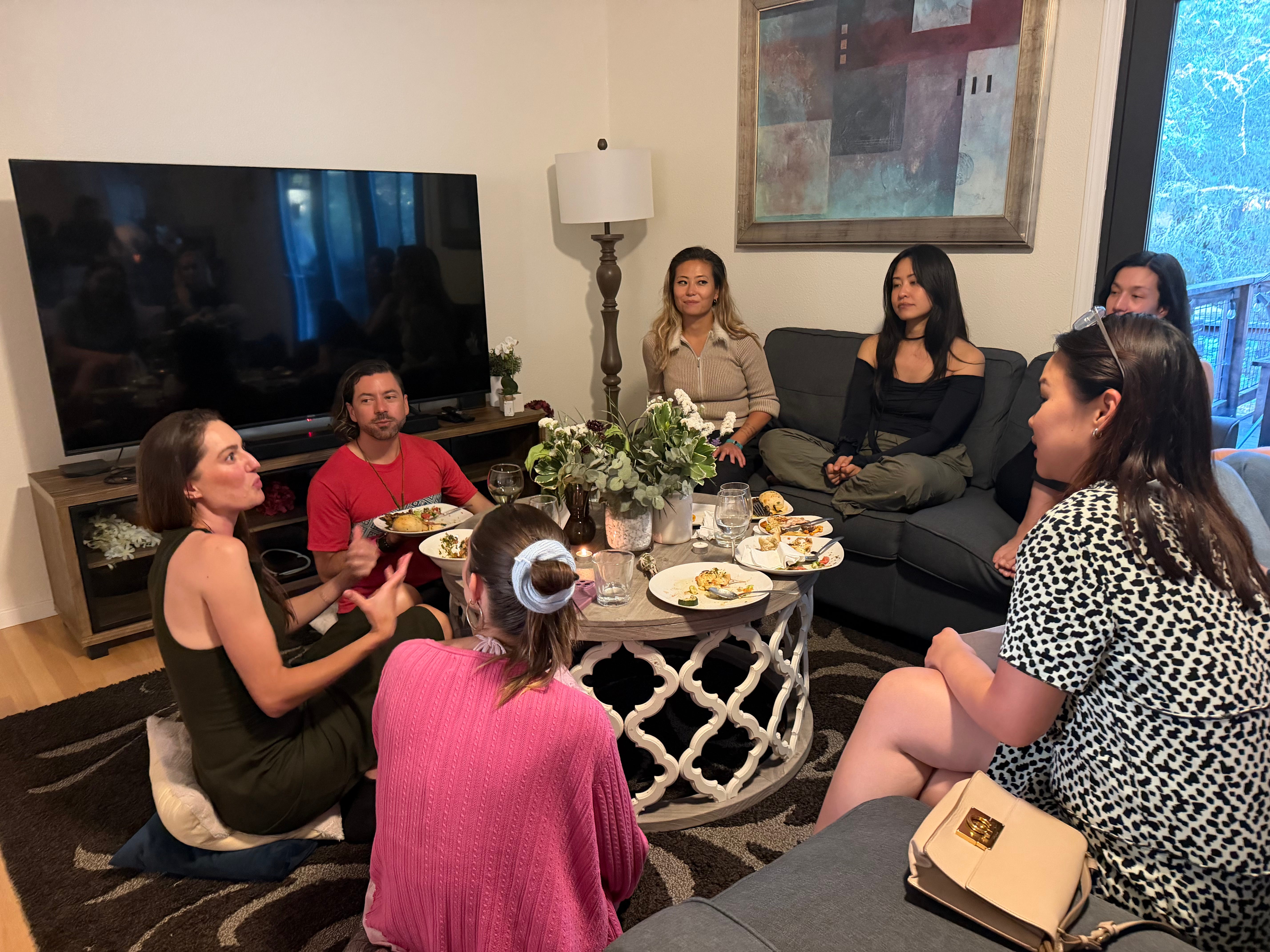
The challenge is the balance between intimacy -vs- openness. If we open up to too many people, our living room becomes chaotic. At the same time, we want to open up this experience to as many people as we can. So, we came up with this system:
Create the event on Luma with a price, paying often encourages people to commit to come, and it’s easier for the chefs to do head counts.
Send out invitations via word of mouth (or sometimes post it to Edge City for better visibility)
Leveraged AI Agent matchmaking for targeted outreach (thanks to the Agent Village experiment at Edge Esmeralda)
Rotate invitations next time with a mixture of residents & fresh visitors
Some events are more targeted with a theme, some are general purposed.
It is an easy thing to say yes to given that the average cost of dinning out at a restaurant is 20-30% more expensive than what we charge at our dinner parties. Our Touch Grass residents also get a 50% discount to help facilitate deeper resident connections.
Subscribe to the Agartha Luma for future events next to you!
Flow of the Night 🥂
Arrival:
Warm greeting, unhurried start.
Quick group intro, each person says something unique about themselves, such as ‘what are you grateful for today’ or ‘what is your creative outlet’? The question helps anchor people into the theme of the night.
Buffet style serving
Small ‘MUSE’ groups
We form people to small groups based on random number raffle, we leave conversation prompts on each table, and allow everyone to sit with a table less than 7 people, where they would go around and answer questions on the conversation prompts
After 20-30 minutes, half of the people from each group rotates to the next table, and conversation switches.
This is repeated 3-4 times
Special talks & events
Sometimes we would follow with lightning talks, featured presentations, or board games, other times people just fizzle out.
Clean up
We make an announcement before dinner starts to encourage everyone to clean up before they leave, forming a nice habit among our residents and guests so that the work on hosting can be manageable.
Cleaning up is a continuation of connecting with others, so people are often motivated to join and there’s often not enough spots for cleaning up.
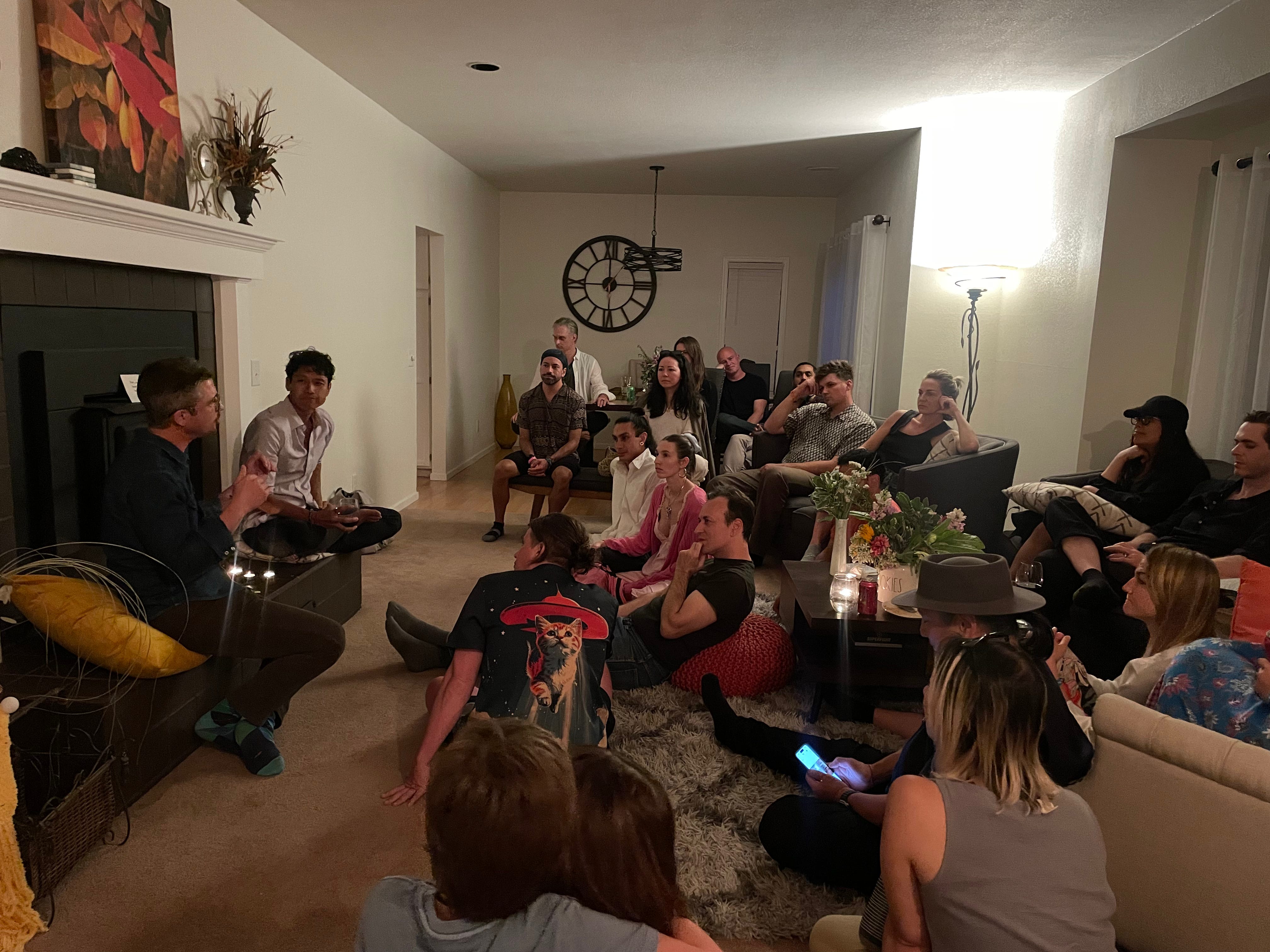
The Food
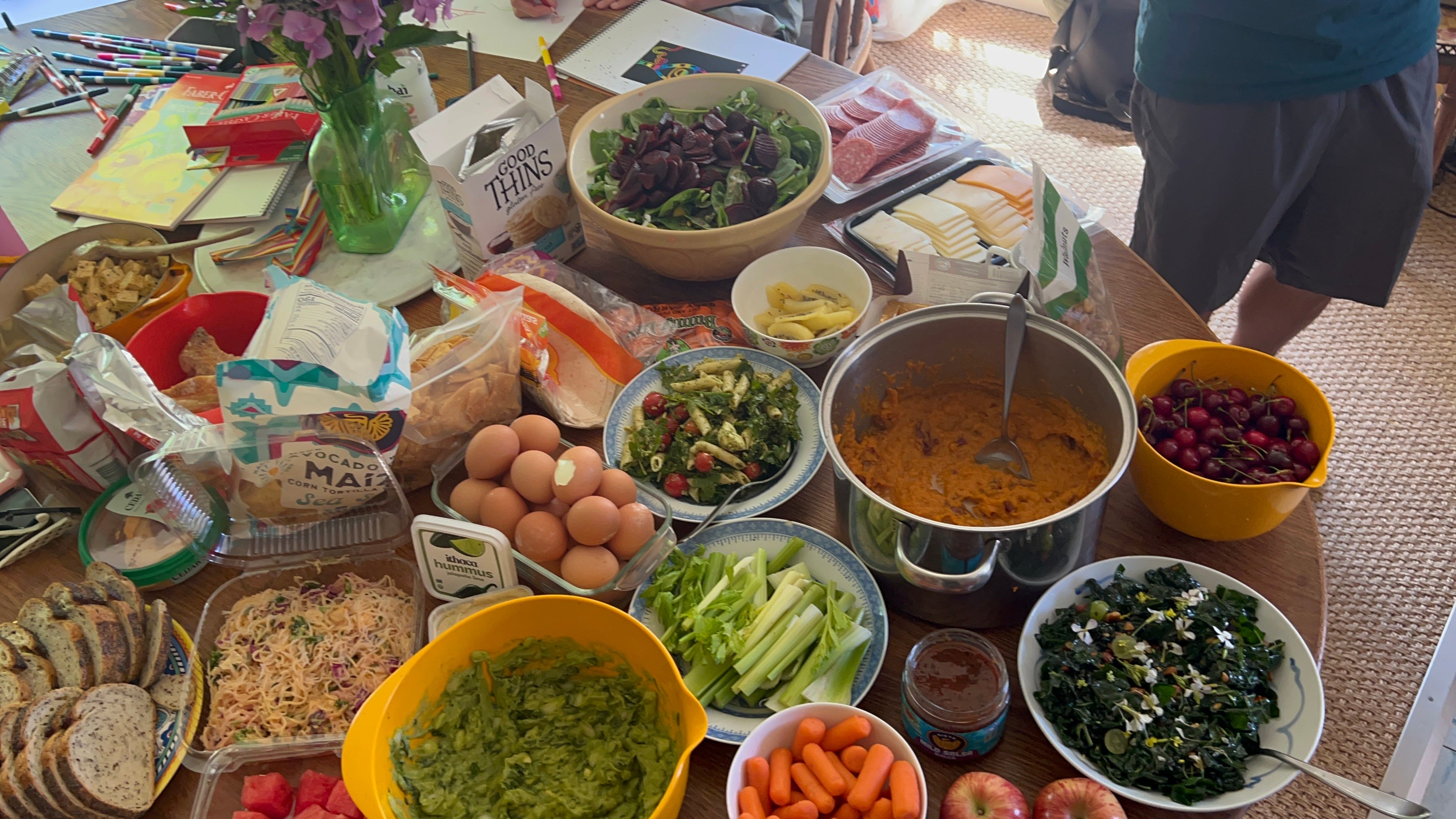
We want a lifestyle where healthy is by design. About 50% of the ingredients used are sourced organically and all organic waste goes to regional compost. Because of the time and budget constraint we have this time, we couldn’t reach 100% local, organic, and plastic packaging free, though I aim for that to become a standard in the future, and be more rigorous about the execution.
We make sure each meal covers a variety amount of nutrients: green veggies, complex carbs, fiber, and healthy protein sources. Each meal captain gets to decide on the type of cuisine, we rotated around Vietnamese, Chinese, US Sothern home-grills, and Filipino. The chef handles the recipe and food shopping, and they usually have a few helpers.
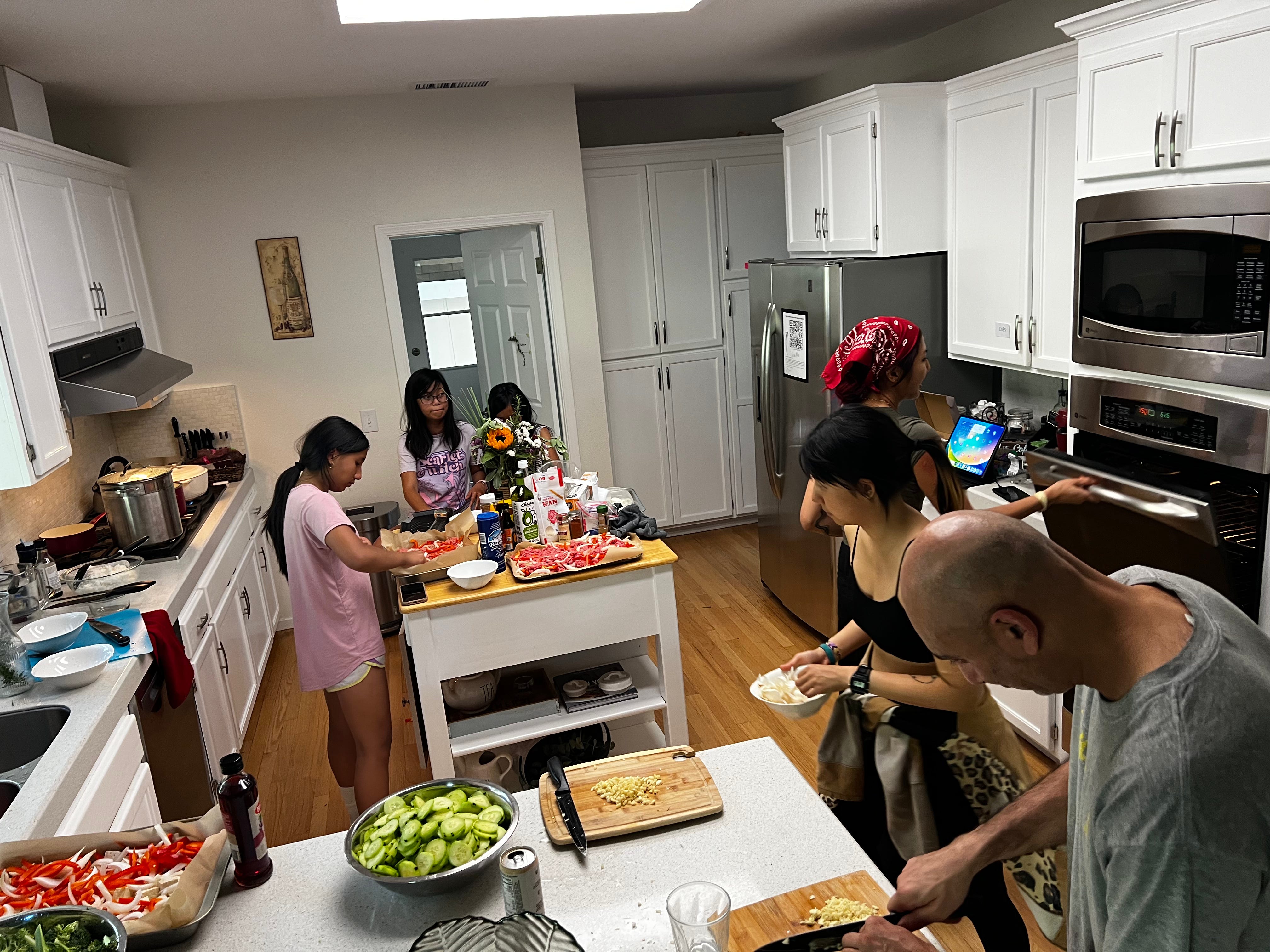
Fried, processed, and high sugar foods are kept to a minimum, although not completely removed. Alcohol is sometimes present, but not in a heavy amount. People might leave tipsy, but nobody gets drunk.
All food costs are covered via event tickets ($15 for guests and $7 for Touch Grass residents), so we could run these events indefinitely.
Sometimes when we have bigger events, we ask for potluck. The key is to be very explicit. We would write in our event description say things like: ‘Please bring enough food for you to consume, or purchase a paid ticket.’ And at the beginning of the event, we would tell people about what we’re missing, asking for complimentary gifts, so that we don’t end up with only desserts or only bread.
The Ambiance 🕯️
Having shared meals with plastic wrappings over beers poured in plastic cups in a room filled with iridescent white lights -vs- having shared meals in a room lit by candles, with rose smelling incense, over gentle piano jazz music — are two completely separate experiences, even if the foods are exactly the same.
I have to give a special shoutout to julie nguyen and Rachel for facilitating one of the most amazing, high-touch, extremely detailed experiences I have seen.
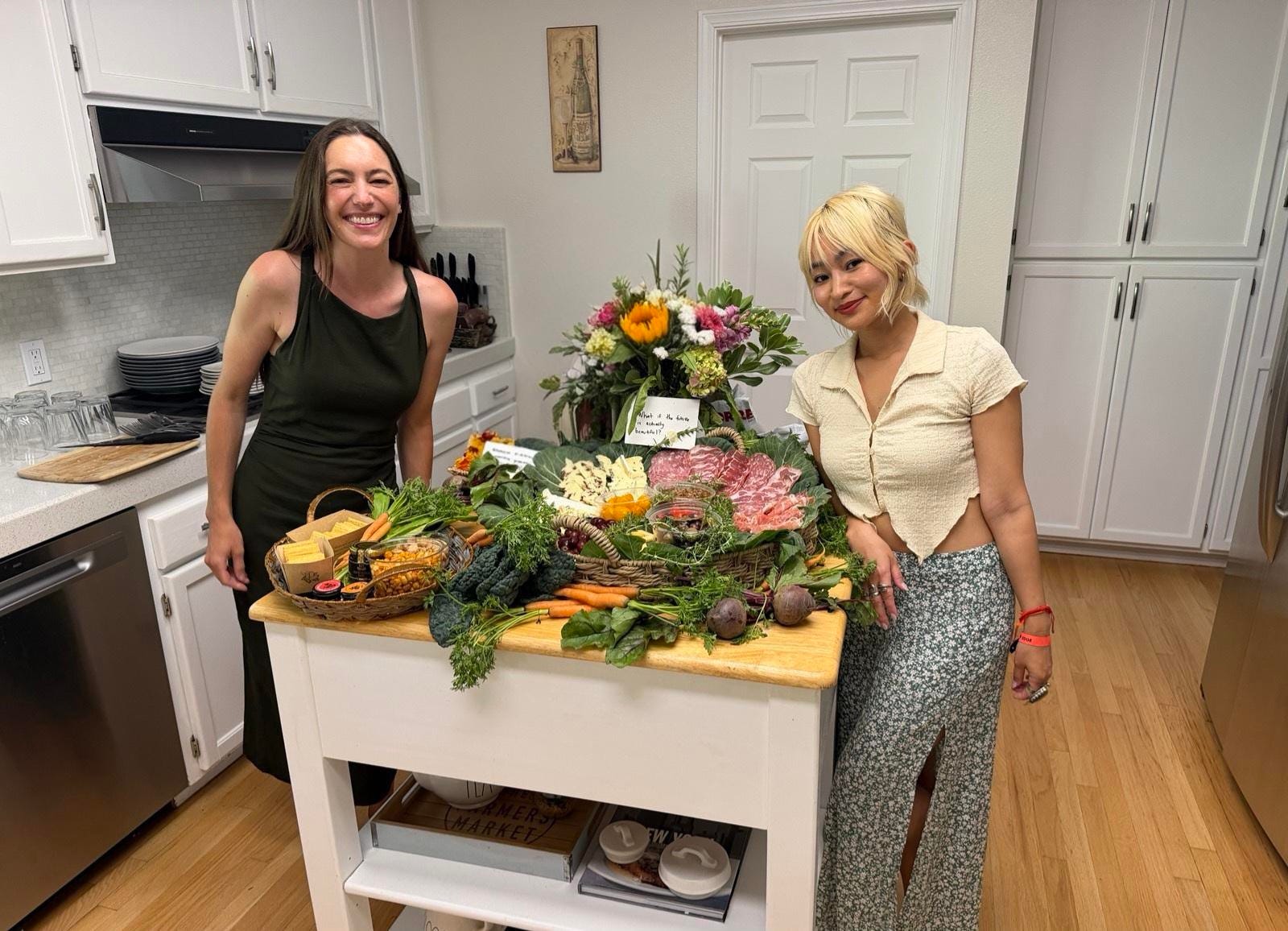
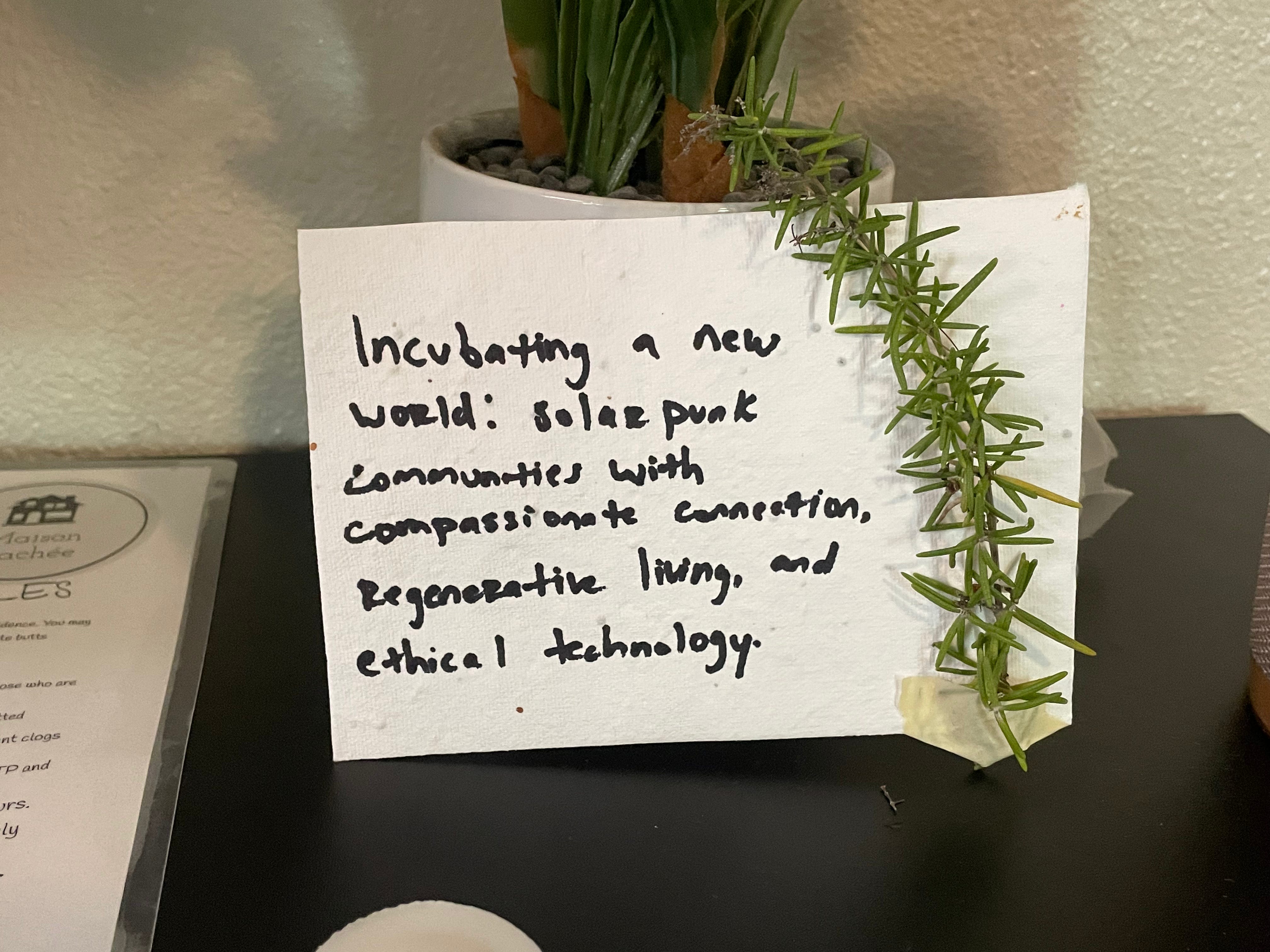
Things worth calling out that these 2 did really well:
Filled the room with plants and flowers harnessed nearby. It really cheered people up. 🌼🌷🌿
Craft papers filled wildflower seeds and wrote many ‘Solapunk quotes’ (some from this blog!) on them and placed them all around the room.
Filled the room with great smells of incense, and gentle dinner music
Very well structured time and flow of events
A beautiful display of foods which people found to be amazing, and impressed ✨
They were very open, warm, and pleasant to be around the whole evening, everyone felt loved and seen after that experience.
Candles are everywhere to be found!
Dinner Activities
Please take these ideas to your community and run them! Leave a comment if you got more ideas and suggestions ;)
Story Circle: Each person in the pod tells a short true story on a theme — a time you felt truly alive, a place that felt like home, what do we imagine if the future is actually beautiful? — and the others practice deep listening, no cross-talk.
Thread: oral tradition is ancient tech; “the future is ancient.” Lands deep without feeling like an interview.
Fishbowl: Instead of a talk-at-the-room, the speaker sits in a small inner circle of 3–4 having a real conversation while everyone else listens in. Leave one empty chair — anyone can tap in for a few minutes, then step out. It turns a lecture into a living thing and dissolves the hierarchy.
Thread: “we’re all players in the same story.”
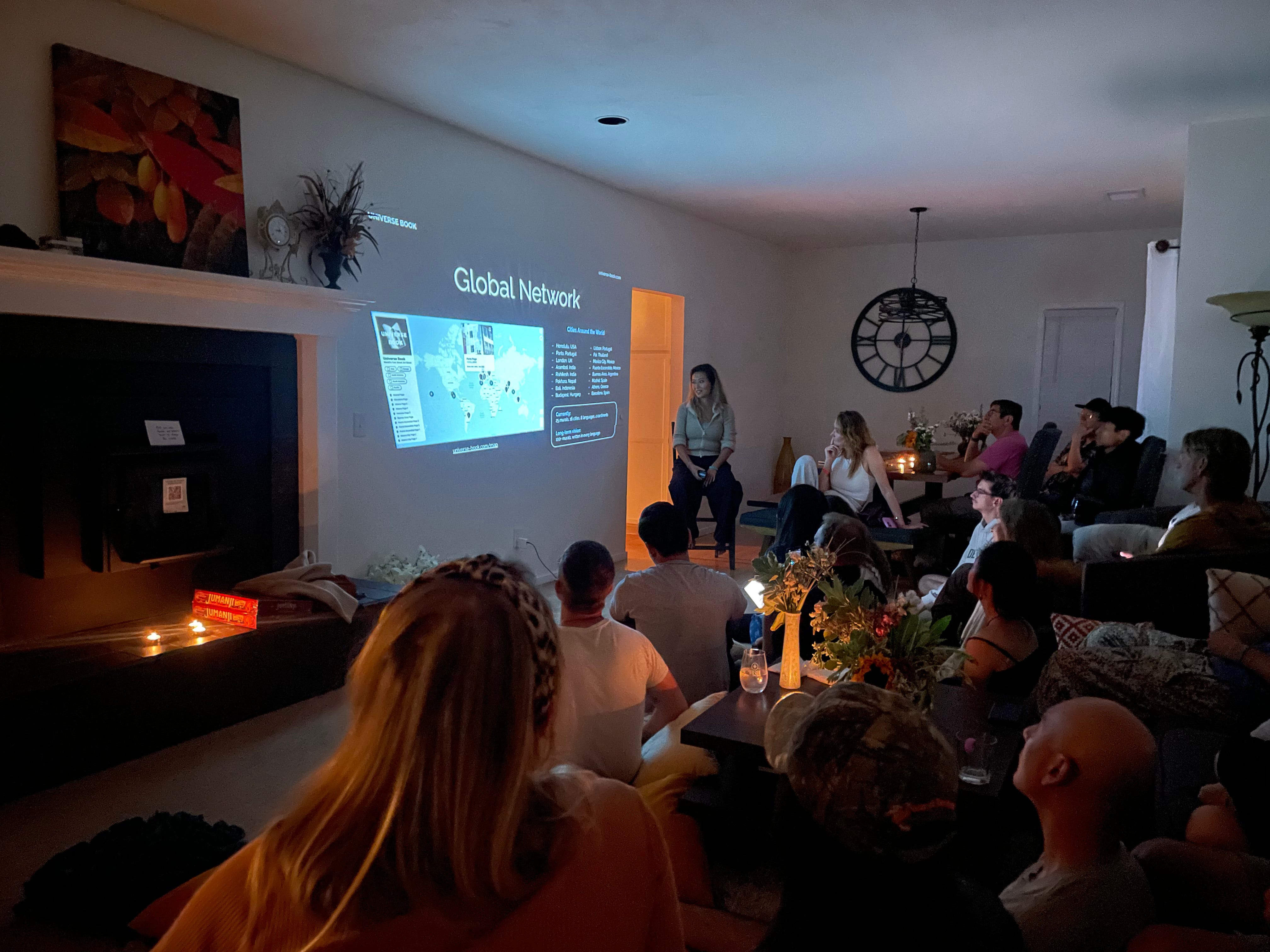
Lightning Talks + pod debrief
Multiple guests each give a 5-minute talk on something they love or are building that’s related to the theme of the evening - what it means to buy land, what does sustainability look like in your life (or 6 slides × 20 seconds, Pecha Kucha style).
Then everyone breaks into small groups to react: what landed, what would you build on? Or do their own style of lightning talks that everyone listens to.
Thread: learning something new, highlighting builders.
World Café
A big question per round, such as: How do we make the beautiful future feel inevitable? Each small table has a host who stays; everyone else rotates tables between rounds, carrying ideas across. Write/draw on the tablecloth. By the end the whole room has cross-pollinated.
Thread: collective intelligence, non-hierarchical.
Dreamstorming
The hosts describe, in vivid sensory detail, a single ordinary day in the future they actually want — what you wake to, eat, who’s there. Then share. It moves people from critique into desire, which is where Solarpunk lives.
Thread: “What if the future is actually beautiful?”
Teach-One-Thing
Each person teaches a tiny skill or shares one tool in five minutes — a breath, a knot, a composting trick, a chord. Reciprocity made literal.
Thread: “yes-and,” co-creation, the gift economy of a real community.
Letter to the Future
Write to your future self, read aloud, or keep it in secrete. Use one wild flower seed paper and everyone writes an intention. Invite them to plant it at their home and so that their intentions will grow and last beyond the dinner.
Thread: The first step of manifesting dreams is to define it.
Question Prompts
These dinner questions are some of the most fruitful outcome from these events:
Dream
What’s something you want that you’ve stopped explaining to people?
If you stopped optimizing for anything, what would your life look like?
What’s a version of success you used to want that you’ve quietly let go of?
Truth
What are you pretending to be okay with?
What would the people who knew you at 15 be surprised to find out about you now?
What’s something you’re afraid to want?
Embodiment
What’s a texture, smell, or sound you keep returning to without knowing why?
When did you last do something with your hands that had nothing to do with output?
What does rest actually feel like in your body — and when did you last have it?
The Easiest Way to Spread Some Love
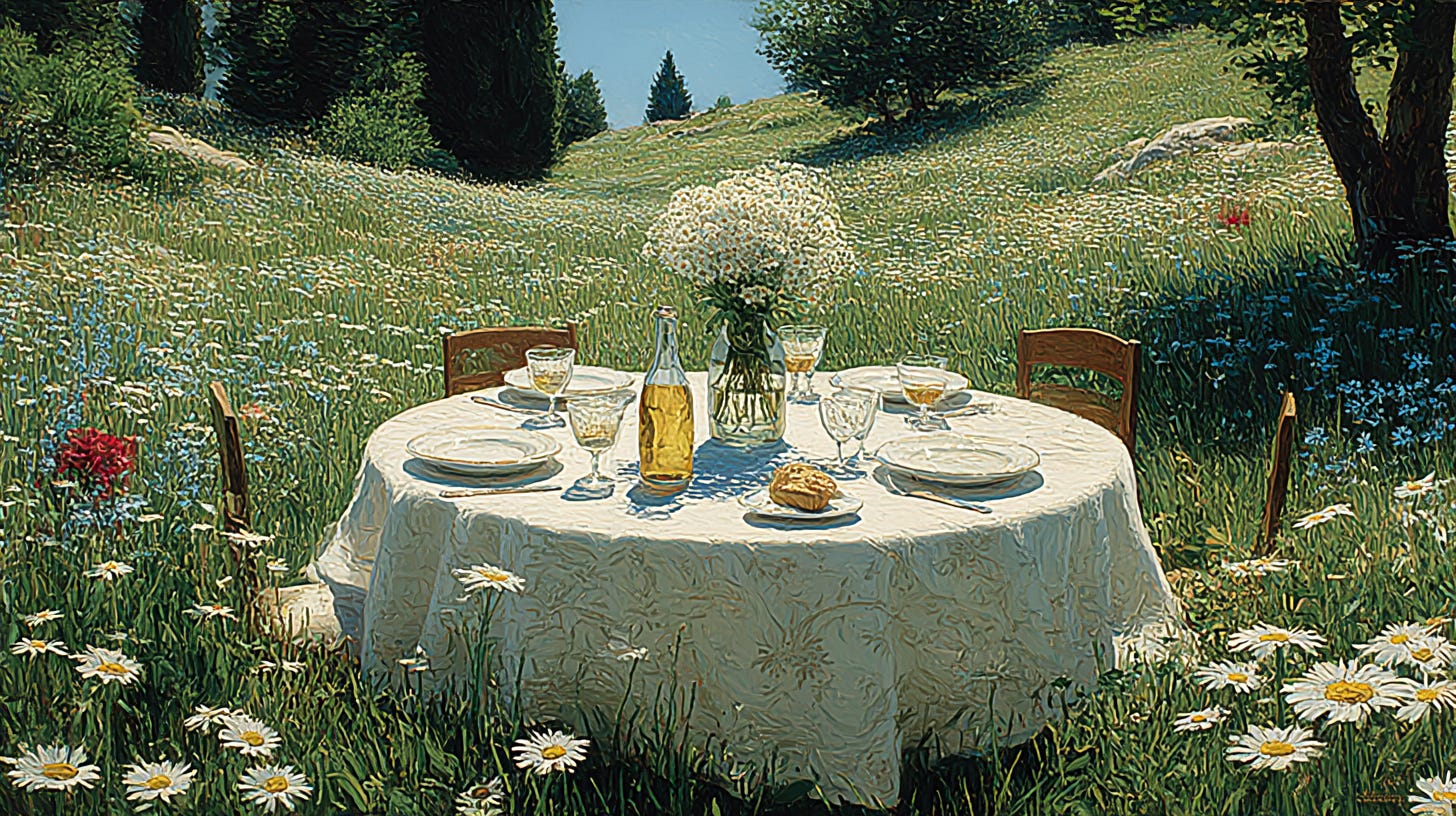
Building community is some of the most needed, yet undervalued work. As we live through a new age of isolation and despair, building community intentionally, wherever you are, can only have positive impact to the immediate world around you.
I hope to see more community builders in our world, let’s bring back the traditional ways of living together, where we lived in tribes and villages with lots of mutual care and support for each others.
If you are inspired to build local communities, have been, or know of any examples, PLEASE share them with us in the comment!
✨ Thanks for reading! Agartha is building a network of Solarpunk builders.💕
Join us as we chronicle our journey through residencies, co-living places, pop-up cities, regenerative villages, and Solarpunk lifestyles. ☀️